
 EL
EL  EN
EN  FR
FR  RU
RU  DE
DE  AR
AR  ES
ES  PT
PT  IT
IT  NL
NL  PL
PL  SL
SL  ET
ET  RO
RO  CS
CS  LV
LV 
You want to sell custom big dog collars, but you have a nagging fear. You worry that the products you source are not truly heavy-duty. A single failure on a powerful dog could destroy your customer's trust and your brand's reputation forever.
A truly heavy-duty collar is an engineered system. It is defined by the synergy between industrial-strength materials, reinforced construction methods, and fail-proof hardware1. When these three elements are correctly specified and combined, they create a product that ensures both safety and durability.

My name is Cathy, and I am a pet gear customization expert at qqpets. I talk to brand owners every day who are passionate about serving the "big dog" market. They know that owners of large, powerful breeds are not just buying a collar; they are buying peace of mind. But the term "heavy-duty" is used so loosely by so many suppliers that it has almost lost its meaning. My purpose today is to give that meaning back. I want to walk you through the specific, verifiable details that separate a genuinely strong collar from one that just looks the part. This is not just technical information; this is the knowledge you need to build a brand that big dog owners can trust with the safety of their beloved companions.
Are the materials in your big dog collars their weakest link?
You see "durable nylon" on a supplier's spec sheet, but what does that really mean? You are concerned that the webbing is too thin and flimsy. Using a standard, low-grade material for a collar meant for a 100-pound dog is a catastrophic failure waiting to happen.
Heavy-duty collars must be built with high-density, thick webbing with a certified high tensile strength2. The choice between specialized nylon and polyester, the thickness of the material, and its weave density are all critical decisions that define the collar's core strength.

The foundation of any heavy-duty collar is the webbing. It is the main component, and it does most of the work. Thinking that all "nylon" is the same is the first and most common mistake a brand can make. Standard nylon webbing, like the kind used for backpacks or light-duty straps, is completely inappropriate for a large dog3. It lacks the thickness and weave density to withstand sudden, powerful lunges, and it will stretch and weaken over time. A truly heavy-duty product requires a material that has been specifically engineered and selected for high-stress applications. As a brand owner, this is the first detail you must get right. The material specifications are where safety begins. A real manufacturing partner will be able to provide you with these exact specifications, not just vague marketing terms. Our process ensures you know exactly what you are getting, because you will approve it yourself in the sample.
Deconstructing Heavy-Duty Webbing Materials
The most important metric for webbing is its "tensile strength." This is a precise measurement of the breaking force a material can withstand. For collars designed for large breeds, you should be looking for webbing with a tensile strength of hundreds, if not thousands, of pounds4. But strength is not the only factor. The material's resistance to environmental factors is also crucial for its longevity and safety.
- High-Density Nylon Webbing: This is the industry standard for a reason. It has excellent strength and abrasion resistance5. However, it can absorb water6, which can cause it to stretch slightly and take longer to dry.
- Polyester Webbing: Polyester has a similar strength profile to nylon but with some key advantages. It has very low water absorption7, meaning it will not stretch when wet and dries quickly. It also has superior resistance to UV degradation8, making it an excellent choice for dogs who spend a lot of time outdoors.
- Tubular Nylon Webbing: This is a premium option where the webbing is woven into a hollow tube and then flattened9. This construction makes it incredibly strong and abrasion-resistant, with a softer edge that is less likely to chafe a dog's neck.
When you partner with us, you are not limited to a single option. We can help you select the perfect material for your brand's specific needs, and our "Sample in 3 Days" promise means you can feel the difference in quality with your own hands.
| Webbing Material | Tensile Strength | Water Absorption | UV Resistance | Best For... |
|---|---|---|---|---|
| Standard Nylon | Medium | High | Medium | Light-duty applications, NOT for big dogs. |
| High-Density Nylon | High | Medium | Good | All-around strength and durability. |
| Πολυεστέρας | High | Very Low | Excellent | Dogs in wet climates or with high sun exposure. |
| Tubular Nylon | Very High | Medium | Good | Maximum strength and comfort, premium tactical gear. |
How can stitching transform a collar from strong to fail-proof?
You have chosen a strong material, but the collar is still only as strong as its weakest point. A simple, straight line of stitching used to attach the D-ring will snap under the sudden force of a big dog lunging. This is where most low-quality collars fail.
A fail-proof collar uses specialized, reinforced stitching patterns like a "box stitch" or "bar tack" at every single stress point. These patterns, sewn with industrial-grade bonded thread, create a bond that is often stronger than the material itself.

After the material itself, the stitching is the most critical element for safety and durability. This is an area where subpar manufacturers frequently cut corners because good stitching requires more time, more thread, and specialized machinery. The stress points on a dog collar are obvious: anywhere hardware is attached10. This means the point where the D-ring (for the leash) is secured and the points on either side of the buckle are the most likely places for a catastrophic failure. A standard single stitch line is designed only to hold two pieces of fabric together. It has almost no strength against the pulling force, known as shear stress, that a large dog exerts. Reinforced stitching, on the other hand, is a specific engineering solution designed to distribute these forces over a wider area and through multiple, overlapping threads11, dramatically increasing the load capacity.
The Science of Secure Stitching
When you inspect a genuinely heavy-duty collar, you can see the difference in the stitching. It is not just a line; it is a shape.
- Box Stitch (or Box X Stitch): This is the gold standard. The machine sews a square shape, and then sews an "X" inside that square. This creates a powerful, redundant reinforcement that holds strong against forces pulling in any direction. This is what you should demand for attaching D-rings.
- Bar Tack Stitch12: This is a series of very tight, dense zigzag stitches that create a short, thick "bar" of thread. It is used to reinforce very small, high-stress areas and prevent fabric from tearing.
- Industrial Bonded Thread: The thread itself also matters. We use industrial-grade bonded nylon or polyester thread. The "bonding" is a coating that prevents the thread from fraying during high-speed sewing and adds a layer of weather and abrasion resistance. It is significantly stronger than the standard thread used in apparel.
Inspecting these stitching details is a key part of our quality control process. Your "Sample in 3 Days" allows you to become the inspector, to pull on the D-ring and see for yourself that our reinforced stitching is built to last.
| Stitching Factor | Τυποποιημένο κολάρο | qqpets Heavy-Duty Collar | Why It Matters |
|---|---|---|---|
| Pattern at D-Ring | Single Straight Line | Reinforced Box X Stitch | Prevents the D-ring from tearing off under load. |
| Thread Type | Basic Spun Polyester | Industrial Bonded Nylon/Polyester | Stronger, more resistant to abrasion and rot. |
| Stitch Density | Low | High and Concentrated | Creates a solid, unbreakable reinforcement point. |
How can you offer unique designs on such a technical product?
You understand the importance of materials and stitching, but your brand is also built on style. How can you combine this technical, heavy-duty foundation with the unique Προσαρμοσμένα μοτίβα and branding that will make your products stand out and sell?
You achieve this by partnering with a factory that has mastered both engineering and customization. Our system allows you to apply your own unique, AI-generated patterns to a pre-vetted, heavy-duty collar chassis, and visualize it all in our 3D system.
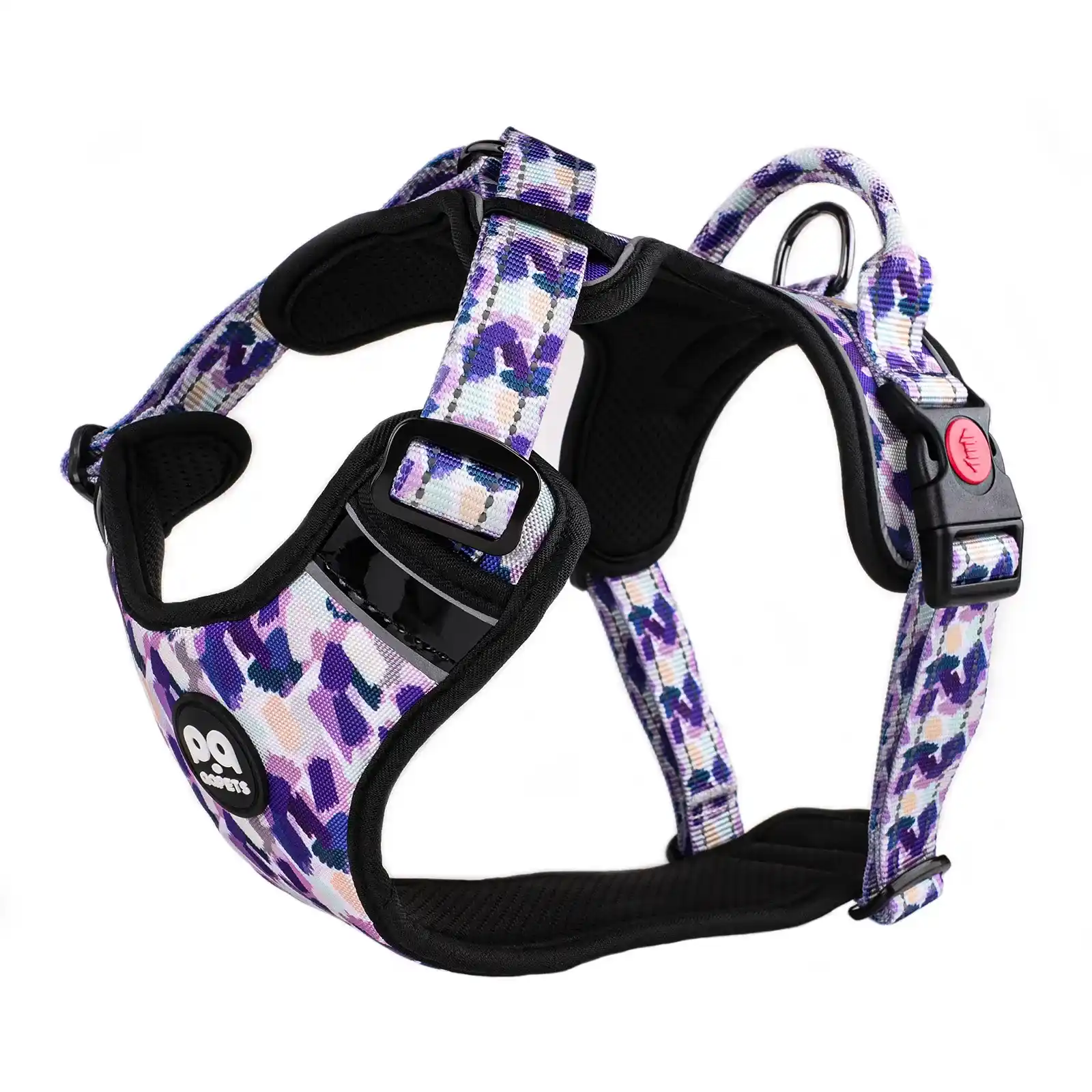
This is where the old way of manufacturing completely breaks down. Traditionally, you had to choose: either a generic, ugly, but strong collar from a technical factory, or a beautiful, custom-designed collar from a fashion-focused factory that might not be safe for a large dog. We believe this is a false choice. As customization experts, we have invested heavily in a system that allows you to have both. Our "lightweight customization" model lets you start with a proven, heavy-duty product base—the right webbing, the reinforced stitching, the fail-proof hardware. Then, we give you the tools to make it uniquely yours. This is how you build a powerful brand: by offering products that deliver uncompromising safety and an undeniable sense of style.
The qqpets System: Engineering Meets Your Imagination
Our entire factory process is built to give online brand owners like you an unfair advantage. Here is how you can easily combine world-class engineering with your unique brand vision.
- Start with a Proven Foundation: We do not start from scratch. We have perfected the heavy-duty collar "chassis," complete with multiple options for high-tensile webbing and load-rated metal hardware. All stress points are already designed with reinforced bar tacks and box stitching.
- Become the Designer: You do not need to hire a designer. Use our free, built-in AI Pattern Generator. You can simply type a description like "a cool geometric pattern with black, grey, and electric blue triangles" and our AI will create exclusive patterns for you.
- Mockup in Seconds: Apply your new pattern to the heavy-duty collar model in our 3D system. You can see exactly how it will look. Then, upload your logo, choose between a PVC patch or a woven label, select the color of the metal buckle, and rotate the final product 360 degrees. It is a "what you see is what you get" process.
- Launch with Confidence: Best of all, you can launch this new, unique, heavy-duty product with a minimum order of just 50 pieces. You can test new designs and build a diverse collection without the massive financial risk.
Ready to build a brand that big dog owners trust? Contact our expert team today and let us show you how easy it can be.
Συμπέρασμα
A truly heavy-duty collar is a system of strong materials, reinforced stitching, and fail-proof hardware. Partnering with a modern factory allows you to customize this system for your brand, easily.
"Tensile Surface Structures: A Practical Guide to Cable and ...", https://www.academia.edu/6427780/Tensile_Surface_Structures_A_Practical_Guide_to_Cable_and_Membrane_Construction. Engineering and textile references describe load-bearing strap assemblies as systems in which webbing, seams, and hardware must each meet the intended load requirements; this supports treating a heavy-duty collar as an integrated load-bearing assembly rather than as webbing alone. Evidence role: general_support; source type: education. Supports: A truly heavy-duty collar is defined by the combined performance of materials, construction methods, and hardware.. Scope note: The source is likely to discuss load-bearing textile assemblies generally, not dog collars specifically. ↩
"Ultimate tensile strength - Wikipedia", https://en.wikipedia.org/wiki/Ultimate_tensile_strength. Materials-science references define tensile strength as the maximum stress or force a material can withstand while being stretched before breaking, supporting its use as a relevant specification for collar webbing. Evidence role: definition; source type: encyclopedia. Supports: Tensile strength is the relevant metric for evaluating the breaking force of webbing.. ↩
"Effect of outdoor exposure and accelerated ageing on ...", https://www.academia.edu/144701433/Effect_of_outdoor_exposure_and_accelerated_ageing_on_textile_materials_used_in_aerostat_and_aircraft_arrester_barrier_nets. Textile and webbing references distinguish light-duty consumer webbing from load-rated webbing by construction, thickness, and breaking strength, providing contextual support for avoiding light-duty webbing in high-load pet restraints. Evidence role: general_support; source type: education. Supports: Light-duty nylon webbing is not appropriate for collars intended to restrain large, powerful dogs.. Scope note: This would support the general distinction between light-duty and load-rated webbing; it may not directly evaluate dog-collar failures. ↩
"1" BLACK Polyester Webbing 3000 lbs - Trucking Depot", https://www.truckingdepot.com/1-inch-black-polyester-tie-down-webbing-3000-lbs-breaking-strength. Manufacturer-independent specifications and technical references for nylon and polyester webbing commonly report breaking strengths in the hundreds to thousands of pounds, supporting the plausibility of this performance range for load-rated webbing. Evidence role: statistic; source type: institution. Supports: Webbing for large-breed collars should be selected from materials with tensile strength in the hundreds or thousands of pounds.. Scope note: Such figures describe webbing materials under specified test conditions and do not by themselves prove the finished collar’s safe working load. ↩
"Polyamides or Nylons (PA)", https://books.byui.edu/plastics_materials_a/polyamides_or_nylons. Polymer and textile references describe nylon fibers as having high tensile strength and good abrasion resistance, supporting the claim that nylon webbing is suitable for durable load-bearing applications. Evidence role: general_support; source type: encyclopedia. Supports: High-density nylon webbing offers strong mechanical performance and abrasion resistance.. Scope note: The performance of a specific collar depends on the grade, weave, thickness, and finishing of the nylon webbing used. ↩
"impact of moisture absorption on 3d printing nylon filament", https://repositories.lib.utexas.edu/bitstreams/9e197366-3c07-474f-9597-88407a15f783/download. Polymer references report that nylon is hygroscopic and absorbs moisture from the environment, supporting the article’s statement that nylon webbing can take up water. Evidence role: mechanism; source type: research. Supports: Nylon can absorb water, which can affect its behavior in wet conditions.. Scope note: The exact amount of water absorption and its effect on a collar depends on nylon type, weave, coatings, and exposure conditions. ↩
"Comparison of Odor Intensity between Nylon and Polyester", https://dr.lib.iastate.edu/handle/20.500.12876/51226. Materials references identify polyester fibers as having low moisture regain compared with nylon and many natural fibers, supporting the claim that polyester webbing absorbs little water. Evidence role: mechanism; source type: education. Supports: Polyester webbing has low water absorption compared with nylon.. Scope note: Low fiber moisture regain does not automatically determine drying time for every woven product because weave density and coatings also matter. ↩
""Analysis of Fiber UV Degradation Through an Environmental ...", https://scholarscompass.vcu.edu/uresposters/429/. Textile weathering references generally find polyester to have better resistance to ultraviolet degradation than nylon, supporting polyester’s use in outdoor applications where sunlight exposure is expected. Evidence role: general_support; source type: research. Supports: Polyester webbing generally has better UV resistance than nylon for outdoor use.. Scope note: UV resistance varies with polymer formulation, dye, stabilizers, and coating, so the support is comparative rather than a guarantee for a specific collar. ↩
"Webbing - Wikipedia", https://en.wikipedia.org/wiki/Webbing. Climbing and rescue references define tubular webbing as webbing woven in a tube shape, often flattened for use, supporting the article’s description of tubular nylon construction. Evidence role: definition; source type: institution. Supports: Tubular nylon webbing is constructed as a hollow tube that is flattened for use.. Scope note: Sources from climbing or rescue contexts describe the webbing structure but may not directly address dog-collar comfort or suitability. ↩
"Stress Concentration Factors for Non-Load-Carrying Welded ...", https://pmc.ncbi.nlm.nih.gov/articles/PMC10856285/. Load-bearing textile design references identify stitched joints and hardware attachment points as critical locations for stress concentration and failure, supporting the article’s focus on D-rings and buckles as collar stress points. Evidence role: mechanism; source type: education. Supports: Hardware attachment points are primary stress points in a collar.. Scope note: The source may address sewn load-bearing assemblies generally rather than pet collars specifically. ↩
"Load-Bearing Strap Design: Stitch Patterns & Webbing | ACW", https://acw1.com/load-bearing-strap-design/. Research on sewn joints and reinforced stitch patterns shows that seam geometry, stitch density, and load distribution influence joint strength, supporting the mechanism by which reinforced stitching can improve load capacity. Evidence role: mechanism; source type: paper. Supports: Reinforced stitching increases load capacity by distributing forces across a wider stitched area and multiple threads.. Scope note: The evidence would support the sewing mechanics broadly; exact strength gains require testing of the specific collar materials and stitch pattern. ↩
"Tips for Sewing Bar Tacks! - Closet Core Patterns Blog", https://blog.closetcorepatterns.com/tips-for-sewing-bar-tacks/. Sewing and technical-apparel references describe bar tacks as dense rows of stitches used to reinforce small areas subject to high stress, supporting the article’s description of their role in load-bearing gear. Evidence role: definition; source type: institution. Supports: A bar tack stitch is used to reinforce compact, high-stress areas and resist tearing.. Scope note: The source may define bar tacking generally and not certify its strength for any particular collar design. ↩