 IT
IT  EN
EN  FR
FR  RU
RU  DE
DE  AR
AR  ES
ES  PT
PT  NL
NL  PL
PL  SL
SL  ET
ET  RO
RO  CS
CS  EL
EL  LV
LV 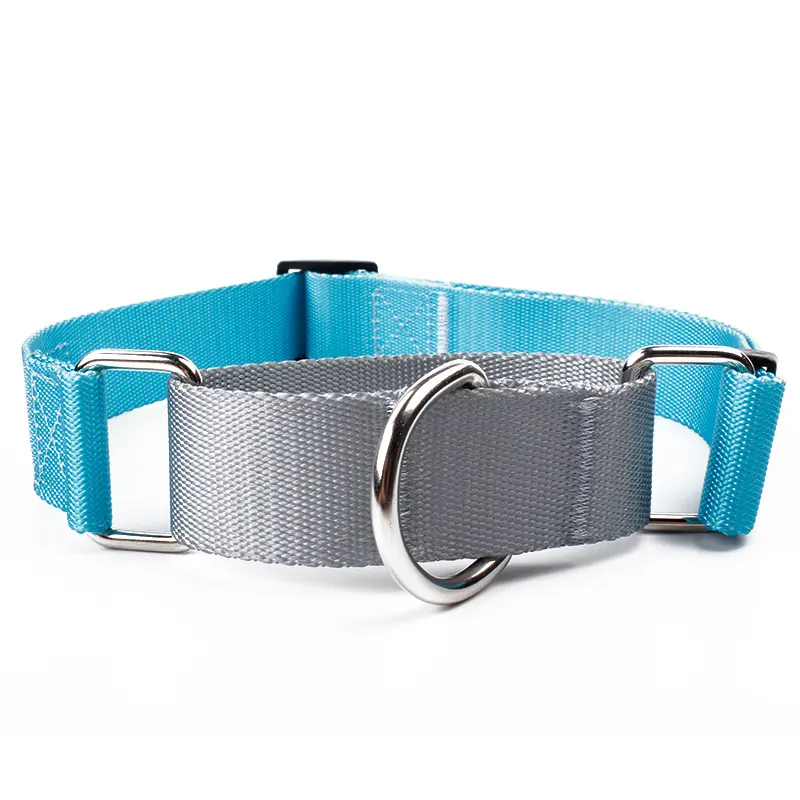
As a UK brand, you want to launch a line of custom 2-inch wide dog collars, but sourcing is a nightmare. Local suppliers are expensive with high MOQs1, while overseas middlemen are slow and communication is a constant struggle.
Many UK brands start with local distributors, but the smartest ones quickly pivot to sourcing directly from specialized Chinese factories. This eliminates markups, grants full design control with digital tools, and provides access to fast, low-volume, high-quality production.
My name is Cathy, and as a custom pet gear specialist at qqpets, a significant number of our most successful partners are online brands from the UK. I've heard their sourcing frustrations firsthand. They feel trapped between paying a fortune for "Made in UK" manufacturing that isn't scalable, or dealing with unreliable trading companies that add zero value. The reality is, the global supply chain has changed. A modern factory like ours is not a distant, anonymous entity; we are a direct, integrated partner. We've built our entire system to solve the exact problems that hold UK brands back, offering a pathway to creating premium, custom products profitably and efficiently.
Why do local UK suppliers charge so much for custom collars?
You've received quotes from UK-based distributors or manufacturers, and the per-unit cost is shockingly high. This makes it impossible for you to achieve a healthy retail margin and compete effectively in the online marketplace.
Local suppliers often act as middlemen.2 They don't manufacture the product; they import it from a factory like ours, add a substantial markup3 to cover their own costs and profit, and then sell it to you. This layered approach is inefficient and expensive.

This is the fundamental issue with the traditional supply chain model. Every person who touches the product between the factory floor and your warehouse adds cost4 without necessarily adding value. For a specialized item like a durable 2-inch collar that requires heavy-duty hardware, these markups become even more significant. Furthermore, these distributors often impose their own high MOQs on you because they themselves have to place a large order with the factory. By working directly with us, you are completely bypassing all of these unnecessary layers.
The Advantage of a Direct Factory-to-Brand Model
You are simply getting access to the same source the big distributors use, but with all the benefits reserved for a direct partner.
- Cost Transparency: Our pricing is factory-direct. You are not paying for an importer's markup, a distributor's warehouse costs, or a sales agent's commission. The savings are passed directly to your brand, dramatically improving your profit margins.
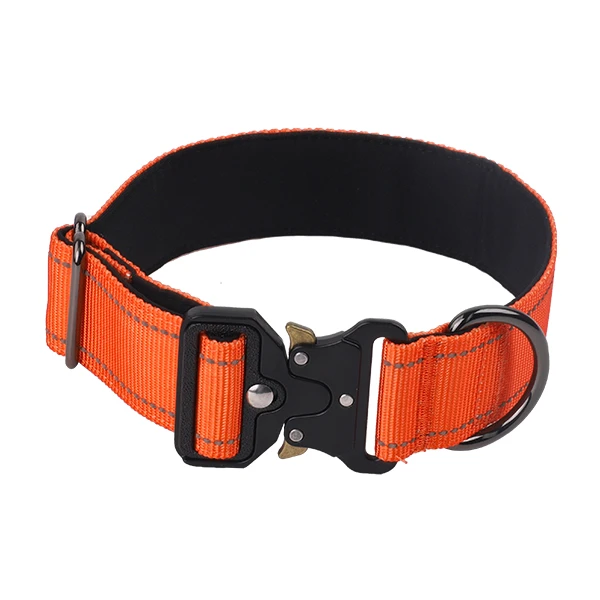
- Low-Risk Entry: We have a "lightweight customization" model specifically for online brands. Our MOQ is just 50 pieces per design. A UK distributor might ask you for 500 or 1,000 pieces5, forcing you into a massive, risky inventory investment. Our low MOQ allows you to test new designs, launch niche products, and manage your cash flow intelligently6.
By removing the middleman, you are not just cutting costs; you are gaining agility, which is the single most important advantage for an online brand.
| Sourcing Method | The Supply Chain | MOQ | Per-Unit Cost |
|---|---|---|---|
| UK Distributor | Factory -> Importer -> Distributor -> Your Brand | High (500+) | High |
| qqpets Factory-Direct | Factory -> Your Brand | Low (50) | Low |
How can you get unique designs quickly without a UK-based designer?
You want your brand to stand out with unique, eye-catching Modelli personalizzati, but you believe that requires hiring an expensive UK-based designer and enduring a slow, painful feedback process with your supplier.
You can become the designer yourself by using a factory partner that provides a powerful, integrated digital design suite7. Our system, featuring an AI pattern generator and a live 3D visualization tool8, lets you create and perfect unique designs from your desk in minutes.

The geographical distance between the UK and China is no longer a barrier to creativity. In fact, our system makes the design process faster and more efficient than working with a local designer and a separate supplier. The old way involved creating a design brief, waiting for the designer's mockups, sending those files to a supplier, and then waiting weeks for a confusing 2D proof that didn't even look right. Our technology collapses that entire timeline into a few clicks. This is why our promise is "Mockup in seconds. Sample in 3 Days."
Your Digital Design Studio, Available 24/7
Il nostro 3D Mockup System is your creative unfair advantage.
- AI-Powered Inspiration: Don't have a design? No problem. Give our AI a prompt. Want something quintessentially British? Try "a stylish argyle pattern in navy blue and red" or "a cute pattern of Queen's Guard soldiers." The AI will generate exclusive, production-ready artwork just for you.
- Instant Visualization: Apply your new pattern (or your own uploaded logo and design) to a photorealistic 3D model of the 2-inch wide collar. Spin it, zoom in, and see exactly how it will look. You can approve your own design instantly, with no room for misinterpretation.
- Rapid Prototyping9: Once you're happy with the 3D mockup, we can produce a physical sample and have it shipped out in as little as three days. You can have a production-quality sample in your hands in the UK faster than many local suppliers can even return your email.
Is it risky to trust a factory in China with quality control?
You're intrigued by the cost and design benefits, but you harbor a legitimate fear about quality. What if the collars arrive and the buckles are weak, the stitching is sloppy, or the colors are wrong? A bad shipment could be a disaster for your brand.
It is not risky when you partner with a professionally certified, transparent, and communicative factory. A reputable factory welcomes scrutiny and provides verifiable proof of its quality standards, such as an ISO 9001 certification10, and has a dedicated English-speaking team to ensure accountability.
This is the single most important factor when choosing an overseas partner, and it's where we focus immense effort. We are not a faceless entity. We are a team of professionals who take pride in our engineering and are fully accountable for the products we ship. Our entire reputation depends on the quality of our output and the success of our brand partners. We understand that for a 2-inch dog collar, quality is directly linked to the safety of a large animal and the peace of mind of its owner.
A System Built on Trust and Transparency
We have built multiple layers of assurance into our process to give our UK partners complete confidence.
- ISO 9001 Certification: This isn't just a piece of paper. It's an internationally recognized standard for quality management systems. It means our production processes—from sourcing raw materials to final inspection—are documented, consistent, and subject to regular audits11.
- Dedicated QC Team: We have a full-time Quality Control team that is independent of the production lines. They conduct inspections at multiple stages, checking the tensile strength of webbing12, the function of every buckle, the integrity of stitching, and the color accuracy of every print.
- Your Professional Service Team: When you partner with us, you are assigned a dedicated, fluent English-speaking account manager. They are your direct line to the factory. They provide updates, answer technical questions, and are your advocate on the factory floor. They ensure there are no communication gaps.
You are never in the dark. If you're ready to explore a more modern, profitable, and creative way to source your products, our team is here to help. Contact us today to start the conversation.
Conclusione
UK brands source their custom collars smart by partnering directly with a modern factory like us. This provides lower costs, faster design, guaranteed quality, and the low-risk MOQs needed to thrive.
"Raw Material Minimum Order Quantity Optimization", https://dspace.mit.edu/bitstream/handle/1721.1/121302/1240293813-MIT.pdf?sequence=1. Manufacturing and operations-management sources describe minimum order quantities as supplier-imposed order thresholds often related to setup costs, batch production, and inventory economics; this supports the concept behind MOQs, not the specific MOQ levels quoted in the article. Evidence role: definition; source type: education. Supports: Minimum order quantities are a standard sourcing constraint tied to manufacturing and inventory economics.. Scope note: Does not verify the particular MOQ figures for UK distributors or qqpets. ↩
"14.5 Placing a Product – Foundations of Business, 2nd ...", https://pressbooks.library.vcu.edu/businessfoundations201/chapter/14-5/. Supply-chain literature defines wholesalers and distributors as intermediaries that purchase, store, and resell goods between producers and retailers; this supports the general mechanism of intermediary sourcing, but not the specific conduct of any UK collar supplier. Evidence role: definition; source type: education. Supports: Local suppliers often function as intermediaries rather than manufacturers.. Scope note: Contextual support only; it does not prove that most UK dog-collar suppliers use this model. ↩
"Manage Consolidation in the Distribution Channel", https://sloanreview.mit.edu/article/manage-consolidation-in-the-distribution-channel/. Research on distribution channels explains that intermediaries add margins to cover logistics, warehousing, sales, and risk-bearing functions; this supports the economic rationale for markups, although it does not quantify markups in the UK pet-accessory sector. Evidence role: mechanism; source type: education. Supports: Intermediaries commonly add margins that increase the final buyer’s unit cost.. Scope note: Does not establish the size of markups for custom dog collars specifically. ↩
"What is Supply Chain Management? Components and ...", https://www.scu.edu/business/blog/business-concepts/what-is-supply-chain-management/. Supply-chain management sources describe how additional handling, transportation, inventory, and transaction stages can increase total landed cost; this supports the cost mechanism, though individual intermediaries may also add services or reduce other costs. Evidence role: mechanism; source type: education. Supports: Additional supply-chain stages can add costs between manufacturing and final delivery.. Scope note: Contextual support; added stages do not always increase net cost in every supply chain. ↩
"How Small Manufacturers Can Develop Risk Management ...", https://www.nist.gov/feature-stories/how-small-manufacturers-can-develop-risk-management-strategies-their-supply-chains. Small-business and trade guidance on overseas manufacturing notes that suppliers may require minimum production runs to make setup and production economical; this offers contextual support for high-order thresholds, but it does not confirm the stated 500–1,000-unit range for UK distributors. Evidence role: general_support; source type: government. Supports: Supplier minimum order requirements can force small brands into larger inventory commitments.. Scope note: Contextual only; the exact quantity range would require market-specific evidence. ↩
"[PDF] Lean production planning and control in semi-process industries", https://upcommons.upc.edu/bitstreams/520cece4-0ad6-4ebb-be09-f7c7e9e7316b/download. Operations and lean-production literature links smaller batch sizes with reduced inventory exposure and faster product experimentation; this supports the general business logic of low-MOQ sourcing, not the profitability of a specific collar launch. Evidence role: mechanism; source type: paper. Supports: Lower order quantities can reduce inventory risk and make product testing easier for small brands.. Scope note: Does not prove that a particular low-MOQ supplier will improve cash flow for every brand. ↩
"(PDF) Digital Prototyping in Industrial Design Pipeline", https://www.academia.edu/119061901/Digital_Prototyping_in_Industrial_Design_Pipeline. Computer-aided design and digital prototyping research shows that integrated digital design tools can support visualization, iteration, and communication before physical production; this supports the general role of such tools, but not the specific capabilities of the company’s platform. Evidence role: mechanism; source type: paper. Supports: Digital design systems can help brands create and refine product designs before production.. Scope note: Contextual support only; it does not validate the advertised tool’s performance. ↩
"The BOND Framework: A Practical Application of Visual ... - PMC", https://pmc.ncbi.nlm.nih.gov/articles/PMC6800736/. Studies of 3D visualization in product design indicate that three-dimensional models can improve spatial understanding and help stakeholders evaluate form and appearance before fabrication; this supports the general design-review benefit, not the accuracy of any single mockup system. Evidence role: mechanism; source type: paper. Supports: Live 3D visualization can help users evaluate a product design before physical sampling.. Scope note: Does not establish that a photorealistic collar mockup will perfectly match mass production. ↩
"Rapid prototyping", https://en.wikipedia.org/wiki/Rapid_prototyping. Engineering literature describes rapid prototyping as a set of methods used to shorten design iteration by producing physical models from digital designs; this supports the general concept of faster sampling, but not the stated three-day sample timeline. Evidence role: definition; source type: encyclopedia. Supports: Rapid prototyping can accelerate the transition from digital design to physical sample.. Scope note: Does not verify the supplier’s specific sample lead time. ↩
"ISO 9000 family - Wikipedia", https://en.wikipedia.org/wiki/ISO_9000_family. The International Organization for Standardization describes ISO 9001 as an internationally used standard specifying requirements for quality management systems; this directly supports the meaning of ISO 9001 certification, but certification alone does not guarantee the quality of every shipped product. Evidence role: definition; source type: institution. Supports: ISO 9001 is an internationally recognized quality-management standard.. Scope note: Certification supports process controls, not defect-free output in every order. ↩
"What is an ISO Surveillance Audit?", https://www.zengrc.com/blog/what-is-an-iso-surveillance-audit/. Accreditation and certification guidance for ISO management systems explains that certified organizations undergo initial and surveillance audits to maintain certification; this supports the audit requirement generally, though audit frequency can vary by certification body and accreditation scheme. Evidence role: mechanism; source type: institution. Supports: ISO-certified quality management systems are periodically audited.. Scope note: Specific audit schedules depend on the certifier and accreditation rules. ↩
"ISO 13934-1:2013(en), Textiles — Tensile properties of fabrics — Part 1", https://www.iso.org/obp/ui/#iso:std:iso:13934:-1:ed-2:v1:en. Textile testing standards and materials-engineering references describe tensile-strength testing as a method for evaluating how much force a fabric or webbing material can withstand before failure; this supports the relevance of tensile testing for collar webbing, not any particular supplier’s test results. Evidence role: mechanism; source type: institution. Supports: Testing webbing tensile strength is a relevant quality-control method for load-bearing textile components.. Scope note: Does not verify the tensile strength of the collars described in the article. ↩