 DE
 EN
 FR
 RU
 AR
 ES
 PT
 IT
 NL
 PL
 SL
 ET
 RO
 CS
 EL
 LV
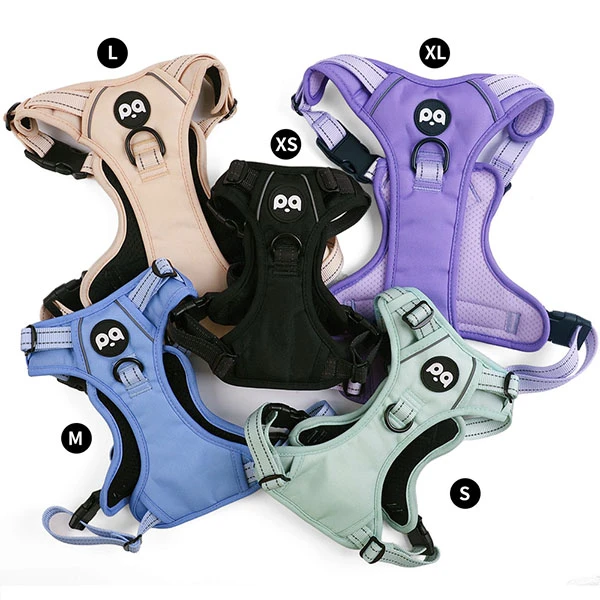
You want to design custom dog collars, but you're struggling to create something truly unique. You fear your products will just blend in with the thousands of other generic collars already on the market.
To make your brand stand out, you must use technology to generate exclusive patterns that nobody else has. Then, you need to ensure those amazing designs are produced on high-quality materials and launch them affordably with a flexible factory partner.

My name is Cathy, and as a pet product customization expert at the qqpets Fabrik, this is the biggest challenge I help brands solve every day. It's not enough to just have a logo; your product itself needs to tell your brand's story. The problem is that the traditional manufacturing process makes true originality incredibly difficult and expensive1. You're often forced to pick from a limited catalog of pre-made patterns, which means you're selling the same product as your competitors. We saw this frustrating reality and decided to build a new system from the ground up—one that puts the power of design directly in your hands and makes launching a unique product simple, fast, and low-risk.
How do you create a truly original pattern that nobody else has?
You have a vision for your brand, but you're not a graphic designer. Hiring one is expensive and time-consuming, and browsing stock image sites for patterns feels uninspired. How can you create a design that is 100% original and exclusive to your brand, without the high cost and long wait?
You can generate your own exclusive patterns in seconds, for free, using artificial intelligence. By simply describing your idea in words, you can create countless unique designs2, ensuring your collars have a look that is impossible for competitors to copy.

In a crowded online marketplace, your design is your first and most important differentiator3. A unique pattern stops the scroll. A unique pattern justifies a premium price4. A unique pattern builds a memorable brand. This is why we have built an AI Pattern Generator directly into our free 3D Mockup System. It's a tool designed to unleash your creativity. You don't need any artistic skill. You just need an idea. For instance, you could type "a pattern of happy Corgis eating pizza," "a watercolor floral pattern with soft pastel colors," or "a bold geometric Art Deco pattern in gold and black." Within seconds, the AI presents you with several completely original Benutzerdefinierte Patterns. You can then use our "Mockup in seconds" feature to instantly apply your new creation to a 3D collar model and see exactly how it will look. One unique pattern means one brand-new product, and you can create as many as you want.
Tertiary Heading: The Design Revolution: From Gatekeeper to Creator
| The Old Way (Expensive & Slow) | The qqpets AI Way (Free & Fast) |
|---|---|
| Hire a freelance designer ($$$). | Generate patterns for free. |
| Wait days or weeks for concepts. | Get dozens of concepts in seconds. |
| Risk using a non-exclusive stock pattern. | Designs are 100% original and exclusive to you. |
| The design process is a major bottleneck. | The design process becomes your competitive advantage. |
You've created a stunning, unique design using AI. But you have a new fear: what if the physical product is a letdown? You're worried the collar will feel cheap, the colors will be dull, the print will scratch off, and the hardware will break. A great design on a poor-quality product is a recipe for bad reviews.
You must partner with a direct factory that controls the entire production process and offers rapid sampling. This ensures that high-quality materials are used, the printing is permanent, and you can approve a physical, production-grade sample in your hands before committing to a bulk order.
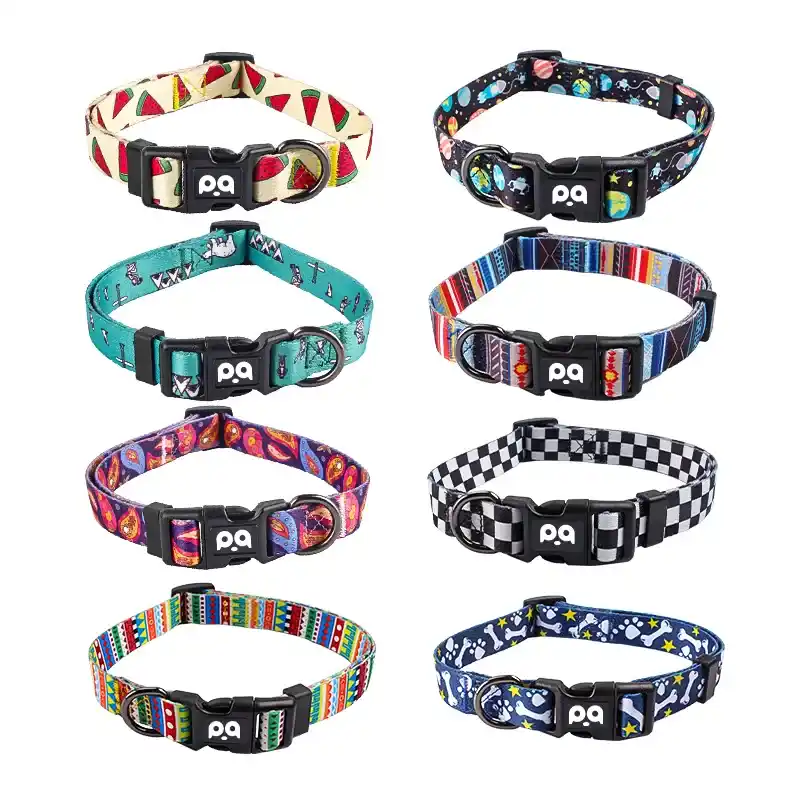
Your brand's reputation is built on the quality of your products. This is non-negotiable. As a factory, not a trading company, we have complete control over every component. We use high-density polyester webbing that is soft to the touch but incredibly strong. Your unique design isn't just printed on top; it's infused directly into the fibers using a dye-sublimation process5. This means the colors are vibrant and the pattern will never crack, peel, or fade6. The hardware, from the buckle to the D-ring, is chosen for durability and safety. But you don't have to take our word for it. Our "Sample in 3 Days" promise is your quality guarantee. We'll produce a physical sample of your exact design and ship it to you fast. You can feel the quality, test the strength, and see the vibrant colors for yourself. This critical step removes all the guesswork and ensures the product you sell is one you can be proud of.
Tertiary Heading: The Anatomy of a High-Quality Custom Collar
- Webbing: High-density polyester for a perfect balance of softness and strength7.
- Printing: Dye-sublimation for a permanent, fade-proof, and scratch-proof design.
- Hardware: Secure, easy-to-use buckles and solid, welded D-rings for safety.
- Stitching: Reinforced box stitching at all stress points to ensure durability8.
- Branding: A clean, crisp custom logo (PVC or woven label) that elevates your brand.
How can a new brand afford to launch a unique, high-quality custom collar?
This is the final, and often biggest, hurdle. You have a unique design and you've verified the quality. But traditional factories demand a Minimum Order Quantity (MOQ) of 500 or even 1,000 pieces. For a new or growing brand, this massive upfront investment is simply too risky.
You can launch your brand affordably by finding a modern factory partner that embraces a "lightweight customization" model. This approach allows you to place orders with a revolutionary low MOQ of just 50 pieces, eliminating the financial risk and empowering you to grow your brand smartly.

The old wholesale model is broken. It was built for a different era. Today's online brands need speed, flexibility, and the ability to test the market without betting the farm9. That's why we built our factory around the principle of "lightweight customization." Our 50-piece MOQ per size and design is a game-changer. It means you don't have to sink all your capital into one product. Instead, you can launch three, four, or even five different standout designs to see which one your audience loves most. This transforms your inventory from a liability into a tool for market research10. You can quickly double down on best-sellers and let go of designs that don't perform. This low-risk, agile approach is how successful brands are built today. We provide the stable lead times and certified quality of a major factory, but with the flexibility and support that a growing brand needs to thrive.
Are you ready to stop dreaming about your brand and start building it? Let's design your standout custom collar together. Contact us today to get started.
Schlussfolgerung
Design a standout custom collar by using free AI for exclusive patterns, verifying with a fast physical sample, and launching affordably with a partner offering a 50-piece minimum order quantity.
"Mass Customization versus Mass Production: Variety and ...", https://www.anderson.ucla.edu/documents/areas/fac/dotm/bio/pdf_CC29.pdf. Research on mass customization describes how traditional mass-production systems rely on standardization and economies of scale, making product variety and individualized design more operationally complex and costly. Evidence role: historical_context; source type: paper. Supports: Traditional manufacturing processes can make highly original, customized product designs difficult and expensive to produce.. Scope note: This supports the general manufacturing context but does not document costs for custom dog collars specifically. ↩
"Personalized Image Generation from an Author's Writing ...", https://arxiv.org/html/2507.03313v1. Studies of text-to-image generative models show that natural-language prompts can be used to synthesize novel images across many visual styles and concepts. Evidence role: mechanism; source type: paper. Supports: Text prompts can be used with AI systems to generate many novel visual design concepts.. Scope note: Such sources support the technical capability of prompt-based image generation, but they do not prove that every generated pattern is legally exclusive or impossible to replicate. ↩
"Package design as a branding tool in the cosmetic industry", https://pmc.ncbi.nlm.nih.gov/articles/PMC9123395/. Marketing and consumer-research literature identifies product design and visual appearance as important cues in consumer evaluation and brand differentiation, particularly where alternatives are numerous. Evidence role: expert_consensus; source type: paper. Supports: Product design can function as a key differentiator in a crowded marketplace.. Scope note: The evidence is likely to be general to consumer products and e-commerce rather than specific to dog collars. ↩
"Willingness to Pay for Customization: The Impact of Choice ...", https://pure.psu.edu/en/publications/willingness-to-pay-for-customization-the-impact-of-choice-variety/. Research on product uniqueness and customization indicates that consumers may assign higher perceived value, and sometimes greater willingness to pay, to differentiated or personalized products. Evidence role: expert_consensus; source type: paper. Supports: Unique or customized designs can support premium pricing under some market conditions.. Scope note: The support is contextual; willingness to pay depends on category, audience, quality, and brand positioning. ↩
"Dye Sublimation | Media Commons", https://mediacommons.psu.edu/project/dye-sublimation/. Technical descriptions of dye-sublimation printing explain that sublimation dyes transition into a gas and diffuse into polyester fibers, forming color within the material rather than sitting only as a surface coating. Evidence role: mechanism; source type: education. Supports: Dye-sublimation printing infuses dye into polyester fibers rather than merely depositing ink on the surface.. Scope note: This supports the mechanism for polyester-compatible sublimation printing, not the quality of any specific factory’s process. ↩
"Optimizing Sublimation Transfer Printing - Clemson OPEN", https://open.clemson.edu/cgi/viewcontent.cgi?article=5453&context=all_theses. Textile-printing references commonly note that sublimation printing on polyester has strong wash and abrasion resistance because the dye penetrates the fiber rather than forming a brittle surface layer. Evidence role: mechanism; source type: paper. Supports: Dye-sublimated polyester prints are generally resistant to cracking, peeling, and fading compared with surface-applied prints.. Scope note: The word “never” is stronger than neutral evidence can usually support; fading can still occur with UV exposure, abrasion, chemicals, or poor process control. ↩
"Performance Properties in Fibers and Fabrics", https://d24-h.tamu.edu/files/2023/02/D2D-Performance-Properties-in-Fibers-and-Fabrics-Copy.pdf. Materials references describe polyester fibers as having high tensile strength, abrasion resistance, dimensional stability, and common use in webbing and textile applications. Evidence role: definition; source type: encyclopedia. Supports: Polyester webbing can provide strength and durability while remaining suitable for textile products.. Scope note: The source can support polyester’s general material properties, but softness depends on yarn, weave, finish, and webbing construction. ↩
"The effects of different fabric types and seam designs on the ...", https://commons.emich.edu/cgi/viewcontent.cgi?article=1052&context=honors. Sewing and textile-engineering sources explain that seam strength depends on stitch type, stitch density, thread, fabric, and reinforcement at load-bearing points. Evidence role: mechanism; source type: education. Supports: Reinforced stitching at stress points can improve the durability of sewn textile products.. Scope note: This supports the general durability rationale for reinforcement, but actual collar strength would require product-specific testing. ↩
"Choosing the “Right” Experiment for Uncertain and Complex ...", https://stvp.stanford.edu/news/choosing-right-experiment-uncertain-and-complex-markets. Lean startup and new-product-development research emphasizes rapid experimentation, validated learning, and iterative market testing as ways for young firms to manage uncertainty. Evidence role: expert_consensus; source type: paper. Supports: New or online brands benefit from fast, flexible market testing to reduce uncertainty.. Scope note: This supports the strategic principle of fast market testing, not the performance of any particular collar launch model. ↩
"Supply Chain Management and Demand Uncertainty", https://scholarworks.uni.edu/cgi/viewcontent.cgi?article=4890&context=grp. Operations-management research on inventory risk and demand uncertainty shows that smaller batches and flexible replenishment can reduce exposure to unsold stock while providing demand information. Evidence role: mechanism; source type: paper. Supports: Small-batch launches can reduce inventory risk and help brands learn which designs have demand.. Scope note: The evidence is contextual; whether small-batch inventory becomes effective market research depends on sales tracking, sample representativeness, and reorder lead times. ↩