 RU
 EN
 FR
 DE
 AR
 ES
 PT
 IT
 NL
 PL
 SL
 ET
 RO
 CS
 EL
 LV
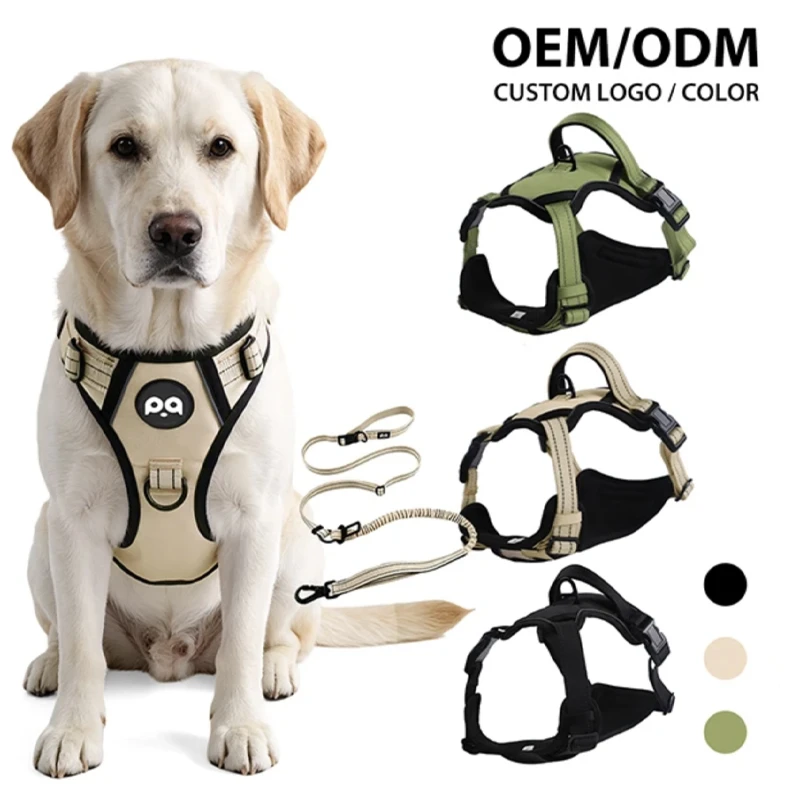
You've designed a stunning custom dog harness, but a terrifying thought keeps you up at night: what if it doesn't fit? You're worried about customer returns, bad reviews, and the safety risk of a poorly fitting product, which could ruin your brand before it even starts.
To ensure the fit of a custom designer dog harness, you must address three areas: select the correct harness style and sizing for the dog's body, use a 3D mockup to perfect the visual fit of your design, and partner with a factory whose production process fits your business.
My name is Cathy, and as a pet product customization expert at the Фабрика qqpets, I know that the question of how to ensure the fit of a custom designer dog harness is one of the most critical challenges for any brand owner. An ill-fitting harness is not just a style problem; it is a comfort, safety, and brand reputation problem.1 The good news is that ensuring a perfect fit is no longer a matter of guesswork. It is a science and a system. The term "fit" goes beyond just measurements. It is about the structural fit on the dog, the brand fit of the design, and the business fit of the production process. We have dedicated our factory to perfecting all three aspects, creating a seamless path for you to launch a product with complete confidence. This guide will show you how.
How can you guarantee the harness structure is right for different dogs?
Dogs come in countless shapes and sizes, from broad-chested bulldogs to slender greyhounds.2 You're anxious that a single harness style won't work for everyone, leading to chafing, escapes, or discomfort for your customers' beloved pets. This is a recipe for customer dissatisfaction.
To guarantee a great structural fit, you must work with a factory that offers a variety of proven harness styles and provides validated, size-graded specifications for each one. This allows you to cater to different breeds and needs with confidence.
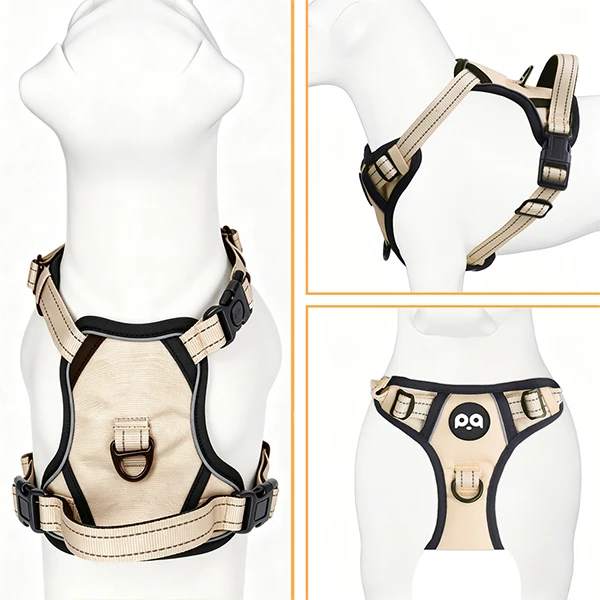
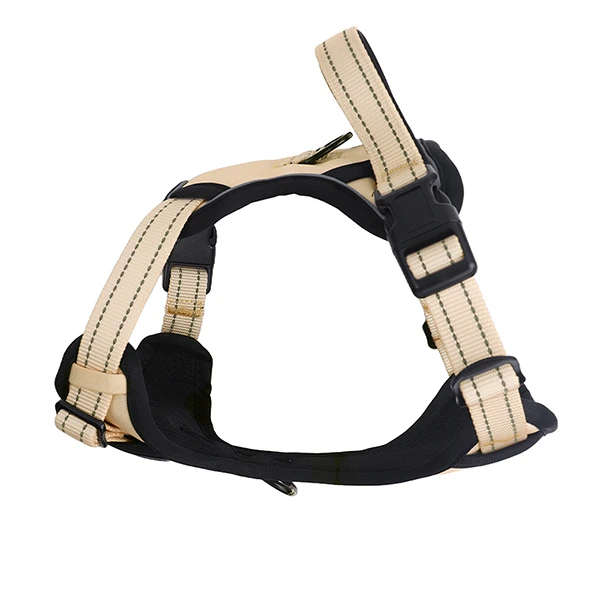
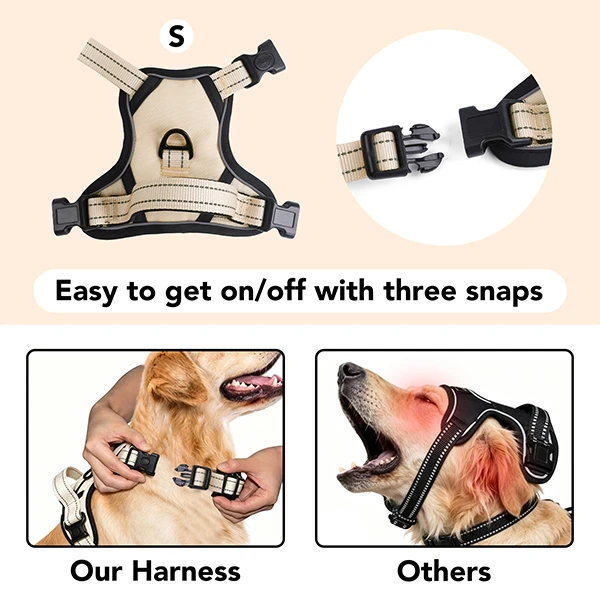
The first layer of "fit" is the most literal: the physical, structural fit of the harness on the dog. A "designer" harness that is uncomfortable or unsafe is a failure. This is where a partnership with an experienced manufacturer is vital. You should not have to reinvent the wheel. We, as pet traction experts, have already invested the research and development into a wide range of harness styles. You get to leverage our expertise. Whether your brand wants to focus on a popular Y-front harness that avoids shoulder restriction3, a comfortable vest-style harness for smaller dogs, or an easy-on step-in harness, we have a perfected template ready for your custom design. Furthermore, each of these styles comes with our proven sizing charts, which have been tested and refined across thousands of dogs. This provides your customers with a reliable guide and ensures your product delivers on its promise of comfort and security.
Tertiary Heading: Choosing the Right Harness Style
The foundation of a good fit is choosing the right structure for the job. Different harnesses serve different purposes.
| Harness Style | Лучшее для | Key Benefit |
|---|---|---|
| Y-Front Harness | Most dog breeds, especially active ones | Avoids restricting shoulder movement, great for control. |
| Жилет Harness | Small to medium breeds, dogs prone to cold | Distributes pressure over a wider area4, provides warmth. |
| Жгуты с шаговым креплением | Anxious dogs, quick walks | Extremely easy to put on and take off without going over the head5. |
Tertiary Heading: The Importance of Proven Sizing
A great style is useless without accurate sizing. A reliable factory provides a complete, graded size chart for each style (e.g., XS, S, M, L, XL) with clear measurement points (neck and chest girth). This is not something you should have to develop from scratch. We provide these tested specifications, saving you time, money, and the risk of developing a product based on flawed measurements.
How do you make sure the visual design 'fits' your brand perfectly?
You have a unique brand identity, but translating it onto the complex shape of a harness is difficult. You are worried that your amazing pattern will be distorted, cut off awkwardly6, or just won't look as good in reality, making your "designer" harness look amateurish.
You ensure a perfect brand fit by using an integrated system that lets you generate infinite patterns with AI and instantly visualize them on a photorealistic 3D harness model7. This guarantees the final look perfectly "fits" your brand vision before any physical production.
The second layer of "fit" is aesthetic: does the final product look and feel like it belongs to your brand? A harness can fit a dog perfectly but still be a failure if the design doesn't "fit" the brand's image. This is where our technology completely changes the game. Using our free and powerful 3D Mockup System, you eliminate all the guesswork. You can create your own unique Пользовательские узоры using our built-in AI generator just by typing a description. Then, with a single click, you can apply that pattern to an interactive 3D model of the exact harness style you chose. This is our "Mockup in seconds" promise. You can rotate the model, zoom in on the details, and see exactly how your pattern flows across every strap and panel. You will see where the seams lie and how your logo will look. This process ensures there are no unpleasant surprises and that the final product is a perfect visual representation of your brand.
Tertiary Heading: From Idea to Perfect Mockup
This process turns a subjective art project into a precise engineering process.
- Generate a Pattern: Use our free AI to create a unique design (e.g., "a repeating pattern of tennis balls and dog bones").
- Select Your Style: Choose the harness structure you want (e.g., Y-Front Harness).
- Apply and Visualize: Instantly see your new pattern perfectly mapped onto the 3D harness model.
- Refine and Approve: Make adjustments until it's perfect. The design you approve on the screen is the design we produce.
How do you ensure the production process 'fits' your business model?
You are a startup or a small online business, not a multinational corporation. The traditional manufacturing model, which requires huge orders and massive upfront payments, simply doesn't fit your budget or your need for agility. You are worried you will be shut out of the market.
You must find a factory partner that offers "lightweight customization." This means a production process specifically designed to fit the needs of online sellers, featuring a very low MOQ (like 50 pieces), stable lead times, and factory-direct support.
This is the final and most crucial layer of "fit." Even with a perfect harness design, the entire project is a non-starter if the manufacturing process doesn't fit your business. We have built our entire factory model around this concept. We are the manufacturing partner for the modern online brand. The centerpiece of this is our industry-leading 50-piece Minimum Order Quantity (MOQ). This low MOQ means the production process "fits" your cash flow. You do not need a massive loan to launch your first product. It "fits" your inventory strategy, allowing you to offer a wide variety of designs and sizes without being buried under unsold stock8. This agility is a massive competitive advantage. Additionally, our process includes a "Sample in 3 Days" guarantee. We send you a physical, finished harness to approve, ensuring the quality "fits" your brand's high standards. With stable delivery times9 and direct communication with our expert team, our entire system is designed to fit your business like a glove.
Are you ready to create a custom designer dog harness that fits perfectly in every way? Our team is here to guide you. Contact our expert team today and let's build your brand together.
Заключение
Ensuring a perfect harness fit means choosing the right style, creating a unique design with AI and 3D mockups, and partnering with a factory that fits your business model.
"Properly Choose & Put On a Dog Harness", https://wendellanimalhospital.com/properly-choose-put-on-a-dog-harness/. Veterinary or animal-welfare guidance on dog harness fitting can document that poor fit may cause discomfort, rubbing, restricted movement, or escape risk, supporting the article’s safety and comfort concern. Evidence role: expert_consensus; source type: institution. Supports: An ill-fitting harness can create comfort and safety problems, not merely aesthetic problems.. Scope note: Such sources will usually support the welfare and safety aspects directly, while the brand-reputation effect is a business inference rather than a veterinary finding. ↩
"The effects of dog breed development on genetic diversity ...", https://pubmed.ncbi.nlm.nih.gov/23679949/. Canine morphology research describes substantial variation in body size, proportions, and conformation among dog breeds, providing context for why harness fit cannot be treated as uniform across breeds. Evidence role: general_support; source type: paper. Supports: Dogs vary widely in body shape and size across breeds.. Scope note: Breed morphology evidence supports the general variation claim but does not evaluate this specific harness product. ↩
"Effects of restrictive and non-restrictive harnesses on ...", https://pubmed.ncbi.nlm.nih.gov/30455191/. Biomechanics studies of canine harnesses examine how harness design can affect shoulder extension and gait, providing support for the claim that designs leaving the shoulder area freer may reduce movement restriction. Evidence role: mechanism; source type: paper. Supports: A Y-front harness design can help avoid shoulder restriction compared with designs that cross or constrain the shoulder.. Scope note: Evidence may compare specific tested harness models, so it should be used as contextual support rather than proof that every Y-front harness avoids restriction. ↩
"Pressure distribution under three different types of ...", https://pubmed.ncbi.nlm.nih.gov/24360734/. Biomechanical principles and veterinary fitting guidance explain that distributing load over a larger contact area can reduce localized pressure, supporting the rationale for wider vest-style harness panels. Evidence role: mechanism; source type: education. Supports: Vest-style harnesses can distribute force over a wider area than narrower straps.. Scope note: This supports the general pressure-distribution mechanism; it does not directly measure pressure for the specific vest harness in the article. ↩
"Effects of Changing Veterinary Handling Techniques on ...", https://pmc.ncbi.nlm.nih.gov/articles/PMC10093362/. Canine handling and behavior literature recognizes that some dogs show stress or avoidance during head and neck handling, giving contextual support for step-in designs that do not need to pass over the head. Evidence role: general_support; source type: paper. Supports: Avoiding over-the-head placement can be useful for some anxious or handling-sensitive dogs.. Scope note: This supports the behavioral rationale, not a direct comparison proving step-in harnesses are better for all anxious dogs. ↩
"3D Garment Design Model Based on Convolution Neural ...", https://pmc.ncbi.nlm.nih.gov/articles/PMC9252671/. Textile and apparel CAD literature discusses the challenge of mapping two-dimensional patterns onto three-dimensional forms and the risk of distortion at seams or curved surfaces, supporting the concern about pattern placement on complex products. Evidence role: mechanism; source type: paper. Supports: Patterns applied to complex three-dimensional textile products can become distorted or awkwardly interrupted without careful visualization and pattern mapping.. Scope note: Most literature may come from apparel or textile engineering rather than pet harness production specifically. ↩
"How 3D Visualization Can Help Eliminate Errors in the ... - blog", https://blog.spatial.com/how-3d-visualization-can-help-eliminate-errors-in-manufacturing-processes. Research on digital prototyping and 3D product visualization shows that virtual models can help designers evaluate product appearance and fit before physical production, supporting the use of a 3D harness model for pre-production review. Evidence role: mechanism; source type: paper. Supports: A photorealistic 3D model can help evaluate a product design before manufacturing.. Scope note: The evidence is likely to support digital prototyping generally rather than this specific harness mockup system. ↩
"The Effect of Product Variety and Inventory Levels on Retail ...", https://www.hbs.edu/faculty/Pages/item.aspx?num=37388. Inventory-management literature describes how product variety increases stock-keeping units and inventory risk, while smaller replenishment quantities can reduce exposure to unsold inventory, supporting the article’s claim about design and size variety. Evidence role: mechanism; source type: paper. Supports: Lower order quantities can make it easier to carry more design and size variants while limiting unsold inventory risk.. Scope note: The source would support the inventory principle, not the profitability of this specific product assortment. ↩
"Supply Chain Management and Demand Uncertainty", https://scholarworks.uni.edu/cgi/viewcontent.cgi?article=4890&context=grp. Supply-chain management research shows that lead-time variability affects inventory planning, service levels, and stockout risk, supporting the importance of stable delivery times for online sellers. Evidence role: mechanism; source type: paper. Supports: Stable delivery times help businesses plan inventory and fulfill orders more reliably.. Scope note: This supports the general operational value of stable lead times, not the supplier’s actual delivery performance. ↩