
 RU
RU  EN
EN  FR
FR  DE
DE  AR
AR  ES
ES  PT
PT  IT
IT  NL
NL  PL
PL  SL
SL  ET
ET  RO
RO  CS
CS  EL
EL  LV
LV 
You sell thick, heavy-duty dog collars for large breeds, but a nagging fear remains. What if a buckle breaks or the stitching rips during a critical moment? This catastrophic failure could injure a dog and destroy your brand's reputation overnight.
The best custom thick dog collars are made fail-proof by using a specific combination of two elements: load-rated metal hardware, like forged buckles and welded D-rings, and reinforced stitching patterns, such as box stitches and bar tacks, at all stress points.
My name is Cathy, and I am a customization expert at qqpets. I speak with brand owners every day who are looking for an edge in the competitive pet market. They know that for the "large and powerful" dog niche, safety is the ultimate selling point. A thick collar is just for show if its components are weak. Therefore, a true manufacturing expert focuses on the engineering of these critical components, and we've built our factory to make that expertise accessible to you.
What type of hardware is truly considered 'fail-proof'?
You're sourcing collars, and the supplier says the hardware is "strong metal." But is it cheap, stamped metal that can bend open1, or is it solid, forged metal designed for heavy loads? This ambiguity creates a huge, hidden risk for your brand.
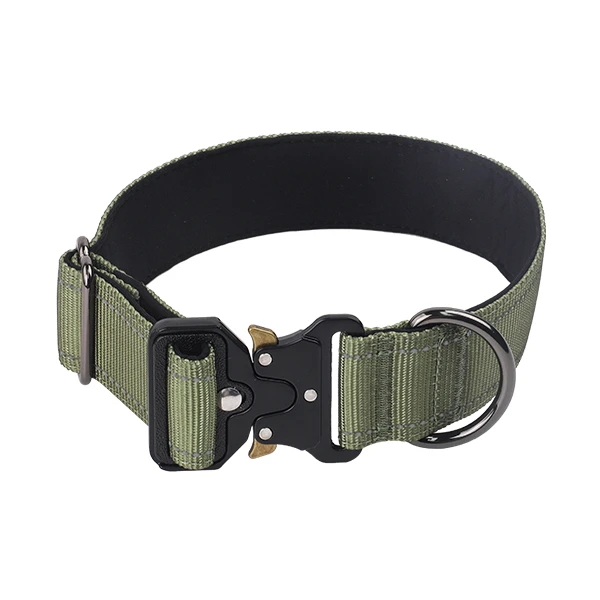
Truly fail-proof hardware is solid-forged or cast metal, such as zinc alloy, stainless steel, or aircraft-grade aluminum2. These components are created without the weak seams or joints found in cheaper hardware3, giving them a verifiable load rating4 that ensures they will not fail under pressure.
Understanding the manufacturing process of the metal itself is crucial. The cheapest hardware is "stamped" from a sheet of metal and bent into shape, leaving a weak point. The "best" hardware is forged, where a solid piece of metal is heated and hammered into shape, creating an incredibly strong, continuous structure5. For D-rings, the key is to use a "welded" ring, which has no gap that can be pulled open by a strong dog. We insist on using these superior hardware options because we know that for your customers, collar failure is not an option.
Hardware Strength Comparison
| Hardware Type | Manufacturing Process | Failure Risk |
|---|---|---|
| Stamped Metal | Bent from a flat sheet. | High: Can bend or pull apart at seams. |
| Cast Metal | Molten metal poured into a mold. | Low: Solid, but can be brittle if low quality. |
| Forged Metal | Hammered into shape from a solid block. | Minimal: Extremely strong and durable; the top choice. |
Why is the stitching pattern more important than the thread itself?
You see a collar sewn with thick nylon thread and assume it's durable. But if it's just a single, straight line of stitching, you have a single point of failure. If one of those threads breaks, the whole seam can unravel quickly under pressure.
The stitching pattern is more important because reinforced patterns, like box stitches and bar tacks, are engineered to distribute force over a wide area. They create redundancy, so if one thread breaks, dozens of others hold the connection firm, preventing catastrophic failure.
Think of it like this: a single straight stitch is a chain, and it's only as strong as its weakest link. A reinforced stitch, however, is a net. A "box stitch" (a square with an X in the middle) and a "bar tack" (a dense series of overlapping zig-zag stitches) are specifically designed for load-bearing points. We use computer-controlled sewing machines to apply these precise patterns to every point where hardware is attached to the webbing. This is a non-negotiable part of our production process. It is this engineering, not just the thickness of the thread, that truly makes a collar fail-proof.
How can you design and verify a fail-proof collar without being an engineer?
You understand the need for forged hardware and box stitching, but communicating these technical specs to a factory feels complex and prone to error. You worry about getting samples that look right but lack the hidden structural integrity you need, wasting your time and money.
You can bypass this complexity by using a smart, visual design system that has the engineering built-in. A system that lets you choose "fail-proof" options and see them instantly in 3D, guaranteeing your design is translated perfectly to the factory floor.
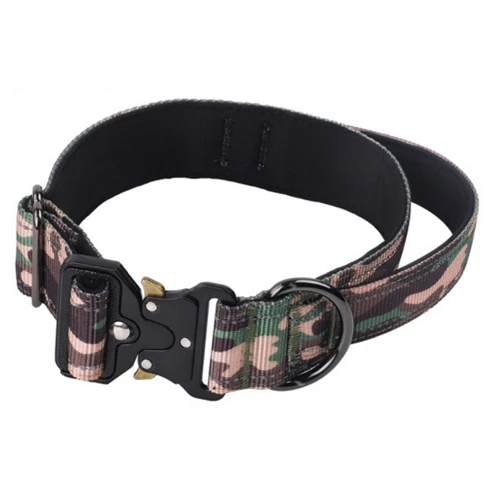
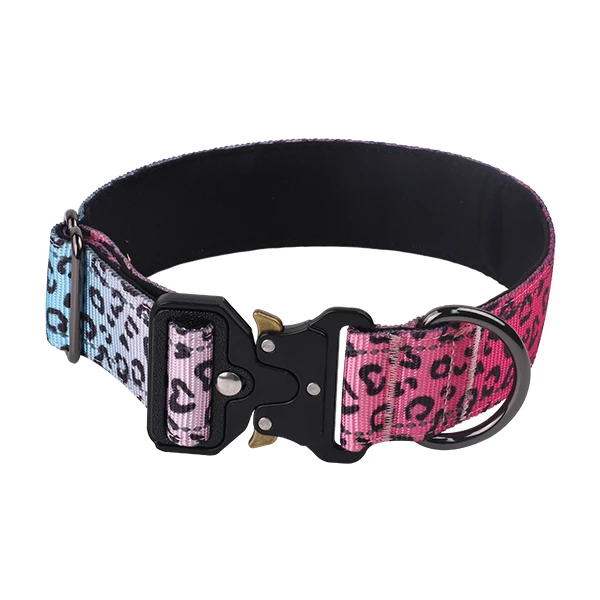
Our factory was built for modern online brands who need speed, accuracy, and confidence. Our promise—"Mockup in seconds. Sample in 3 Days."—is powered by our revolutionary digital tools. With our free 3D Mockup System, you can select a "tactical collar" base that already includes options for premium hardware like Cobra buckles. Then, you can apply your brand's unique Пользовательские узоры, which you can even create using our AI pattern generator. You see your finished, fail-proof product instantly. This visual verification, combined with our low MOQ of just 50 pieces, allows you to launch a top-tier, safety-focused product line with minimal risk.
Are you ready to build a reputation for unquestionable safety and quality? Contact our expert team today and let's create a collar you can be proud of.
Заключение
Fail-proof collars are made with specific load-rated hardware and reinforced stitching. Our factory's digital tools and low-risk production make it easy for your brand to design and verify them.
"Stress_Concentration_Tables.pdf", http://www.unm.edu/~bgreen/ME360/Stress_Concentration_Tables.pdf. Manufacturing references explain that stamped parts are formed from sheet metal and that their strength depends on sheet thickness, geometry, and bends, which can create stress concentrations under load. Evidence role: mechanism; source type: education. Supports: Stamped metal hardware can be more vulnerable to bending or opening if its geometry and material are inadequate for the load.. Scope note: This supports the plausibility of bending risk in thin or poorly designed stamped hardware, but not all stamped metal components are inherently unsafe. ↩
"What is Zinc Die Casting | Zinc Alloy Die Casting in the Automotive Industry", https://www.phbcorp.com/what-is-zinc-die-casting/. Materials references document that stainless steels, aluminum alloys used in aerospace applications, and zinc alloys have distinct mechanical properties that can make them suitable for durable hardware when properly designed and manufactured. Evidence role: general_support; source type: research. Supports: These metal categories can be suitable choices for durable collar hardware when specified and manufactured correctly.. Scope note: Material class alone does not establish fail-proof performance; alloy grade, heat treatment, casting or forging quality, and testing are still necessary. ↩
"Stress Concentration Factors for Non-Load-Carrying Welded ...", https://pmc.ncbi.nlm.nih.gov/articles/PMC10856285/. Mechanical design references discuss joints, seams, and discontinuities as potential stress concentrators where failure can initiate under repeated or high loading. Evidence role: mechanism; source type: education. Supports: Continuous hardware forms can reduce potential weak points compared with components that include seams or joints.. Scope note: This supports the design principle that fewer discontinuities can reduce failure risk, not that every seamed component will fail. ↩
"California Code of Regulations, Title 8, Section 5023. Proof Load Test and ...", https://www.dir.ca.gov/title8/5023.html. Standards and testing references describe tensile, proof-load, or working-load testing as methods used to verify that hardware can withstand specified forces. Evidence role: mechanism; source type: government. Supports: Hardware with a verifiable load rating provides a more objective basis for safety claims than untested hardware.. Scope note: A verified rating applies to the tested component or assembly under defined conditions and should not be interpreted as a guarantee against all real-world failures. ↩
"Forging & Grain Flow", https://trentonforging.com/grain-flow-in-forging/. Metallurgical sources explain that forging can refine grain structure and align grain flow, improving strength and toughness compared with some cast or machined alternatives. Evidence role: mechanism; source type: education. Supports: Forging can improve the mechanical strength and structural continuity of metal hardware.. Scope note: The advantage depends on alloy, forging parameters, heat treatment, and comparison material; it should not be stated as universal for every forged part. ↩